Jump to section
In brief:
• Heavy duty towing covers commercial trucks, construction machinery, and industrial equipment that exceed the weight limits of standard tow trucks.
• Federal weight thresholds, not vehicle type alone, generally determine when a heavy duty rig and specialized trailers are required.
• Quality Towing and Equipment Moving, based in West Chester, OH, handles this category of towing across Cincinnati, Oh.
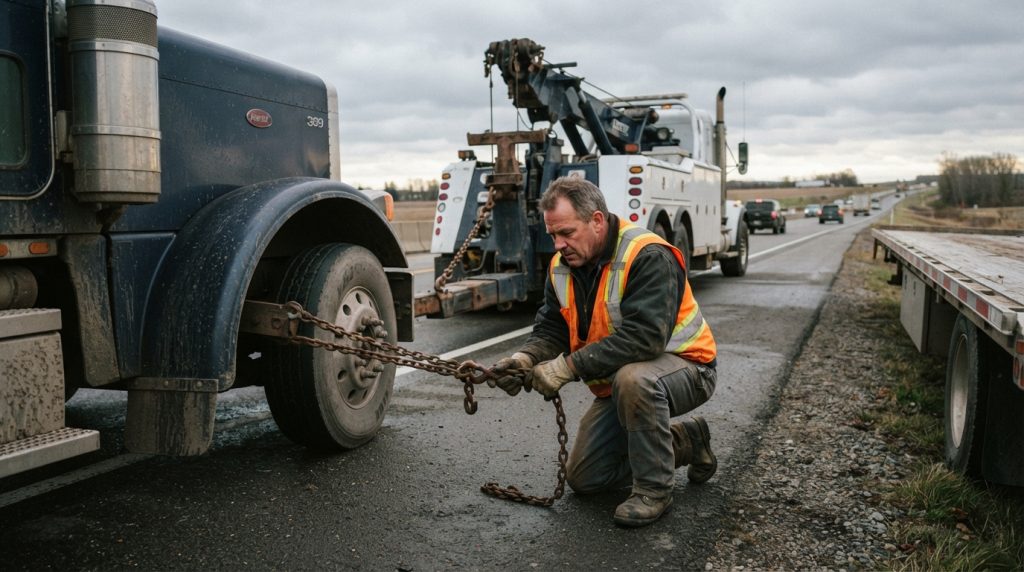
Heavy duty towing refers to moving vehicles and equipment that exceed the capacity of standard tow trucks, typically commercial trucks, construction machinery, and industrial loads weighing well beyond what a light-duty wrecker can safely handle. It relies on specialized trailers, rated chains, and heavier-capacity trucks built for oversized or overweight cargo.
Most readers searching this topic want to know whether their situation calls for a standard tow or something larger. Heavy Duty Towing becomes necessary once a vehicle or machine crosses certain weight and size thresholds that make conventional towing equipment unsafe or ineffective.
What Qualifies as Heavy Duty Towing
Vehicle classification in the towing industry generally follows weight rating rather than appearance. The federal government sets a baseline for this distinction: commercial motor vehicles with a Gross Vehicle Weight Rating over 10,001 pounds fall under FMCSA safety and inspection regulations, which is the same general weight class that typically requires heavy duty towing equipment rather than a standard wrecker.
Common examples include:
• Semi-trucks and tractor-trailers
• Box trucks and delivery fleets
• Construction machinery such as excavators and loaders
• Buses and large recreational vehicles
• Industrial equipment being relocated between job sites
Each of these loads requires trailers and anchor points rated for their actual weight, not just a larger truck cab.
How the Towing Process Works
Moving oversized vehicles or machinery is a multi-step process that differs significantly from a routine car tow.
1. Assessment – the operator confirms weight, dimensions, and the cause of immobilization (breakdown, accident, or scheduled relocation).
2. Equipment matching – a rig and trailer combination suited to the load is selected, which may include flatbed, drop deck, low boy, or multi-axle trailers.
3. Securing the load – chains, straps, and anchor points rated for the specific weight class are used to stabilize the vehicle or equipment.
4. Transport – the load is moved to its destination, following route and permit requirements for oversized cargo where applicable.
Professional hauling setups generally depend on specialized trailers, heavy-duty chains, straps, and secure anchor points designed to handle significant weight, since standard tie-downs are not rated for commercial-scale loads.
When You Actually Need It
Not every roadside breakdown requires this level of equipment. The table below outlines general differences between towing categories.
| Factor | Light/Medium Duty Towing | Heavy Duty Towing |
| Typical vehicle | Passenger cars, pickups, vans | Semi-trucks, buses, heavy machinery |
| Approximate weight | Under 10,000 lbs | Often well above 10,001 lbs GVWR |
| Equipment used | Standard flatbed or wheel-lift | Multi-axle trailers, low boys, drop decks |
| Common scenario | Flat tire, minor breakdown | Highway breakdown, equipment relocation |
Situations that typically call for heavy duty equipment include commercial truck breakdowns on highways, construction equipment that needs to move between job sites, and industrial machinery relocations that exceed what a standard flatbed can carry.
Local Considerations for Cincinnati, Oh
Highway corridors around Cincinnati, Oh carry significant commercial truck traffic, which makes breakdown response times and route planning relevant factors for fleet operators and construction contractors in the area. Seasonal weather, including winter ice and summer heat, can also affect road conditions for oversized loads moving through the region. Based in West Chester, OH, Quality Towing and Equipment Moving serves customers across Cincinnati, Oh with equipment built for commercial and industrial hauling needs.
Frequently Asked Questions
What is the main difference between regular towing and heavy duty towing? Regular towing handles passenger vehicles under roughly 10,000 pounds, while heavy duty towing uses larger rigs and specialized trailers for commercial trucks, buses, and heavy machinery that exceed that threshold.
Can heavy duty towing move construction equipment, not just trucks? Yes. Heavy duty towing and hauling services typically cover construction machinery and industrial equipment in addition to large commercial vehicles.
Does heavy duty towing require special permits? Oversized or overweight loads often require route and transport permits, depending on dimensions and local regulations, so operators typically confirm requirements before transport.
Is heavy duty towing available for emergencies, not just scheduled moves? Both scheduled relocations and emergency breakdowns fall under heavy duty towing, since commercial trucks and machinery can require urgent recovery as well as planned transport.
Business Info
Quality Towing and Equipment Moving operates from West Chester, OH and lists heavy duty towing among its services for commercial trucks, construction machinery, and industrial equipment across the Greater Cincinnati area, according to its Google Business Profile.
Current service area information for Quality Towing and Equipment Moving is maintained for reference by those researching commercial towing options.